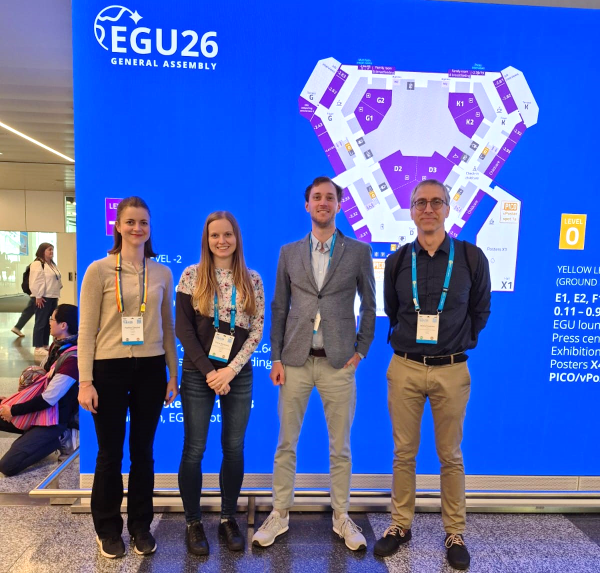
 At the beginning of May 2026, the Urban Ecohydrology team participated in the EGU General Assembly conference in Vienna, one of the world’s largest scientific conferences in the field of geosciences, which this year welcomed more than 22,000 registered participants from 125 countries. For our team, this is a traditional annual event where we regularly present our research results to an international audience. This year, the team’s contributions were presented in the session “Soils, Nature Based Solutions, and Spatial Planning for Climate-Resilient Landscapes” and covered a broad range of topics related to nature-based solutions for sustainable urban water management.
Petra Marešová presented the results of long-term experimental monitoring of a multilayer bioretention cell, focusing on its hydrological performance, runoff dynamics, and evapotranspiration assessment.
Pavlína Žatecká presented results from the Prague City Lab within the Horizon Europe project NBSINFRA. Her poster focused on the thermal and water regime of nature-based solutions. Long-term monitoring data show that green roof temperatures can be up to 30 °C lower than conventional paving on sunny days, while dense sedum vegetation retains nearly 72% of total rainfall.
In his presentation, Marek Petreje introduced an innovative hybrid green roof (HGR) combining a modular rooftop constructed wetland for wastewater treatment with a semi-intensive green roof. This system enables efficient on-site greywater recycling, reducing potable water consumption while simultaneously contributing to urban cooling through evapotranspiration.
Michal Sněhota presented a research focused on the characterization of infiltration processes in engineered technosols for green roofs using bimodal neutron and X-ray tomography. This non-invasive 3D imaging method makes it possible to observe how substrate ageing after installation alters pore structure, infiltration dynamics, and water flow patterns.
Participation in the conference provided the team with an opportunity to receive valuable feedback on ongoing research and establish new connections with international colleagues working in related fields.