Water is part of our everyday lives, yet we rarely stop to think about where it comes from or where it goes after use. The
way we manage water today will determine how much of it is available in the future. Rising water consumption, climate change,
and rapid urbanization are placing increasing pressure on water resources. Finding effective ways to treat, retain, and reuse
water has therefore become an important focus of both research and urban planning.
Sustainable water management today involves not only technological innovation, but also ecosystem protection, equitable access
to water resources, and the thoughtful integration of green, blue, and gray infrastructure – that is, vegetation, water,
and technical solutions working together to support natural hydrological processes in both landscapes and cities. Such measures
can help retain water in urban environments, improve its quality, and at the same time increase cities’ resilience to drought
and extreme rainfall. Their broader implementation, however, is often hindered by financial costs, technological and institutional
barriers, or insufficient legislation.
The Urban Ecohydrology research team at the University Centre for Energy Efficient Buildings of the Czech Technical University
in Prague, therefore focuses on the development of nature-based systems for water treatment and recycling in urban environments.
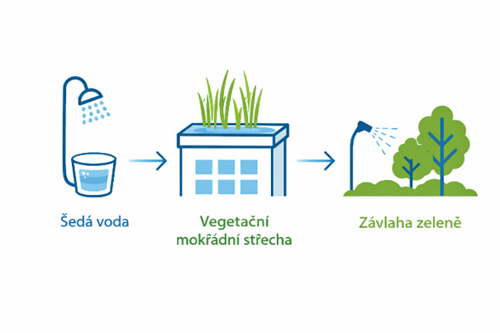
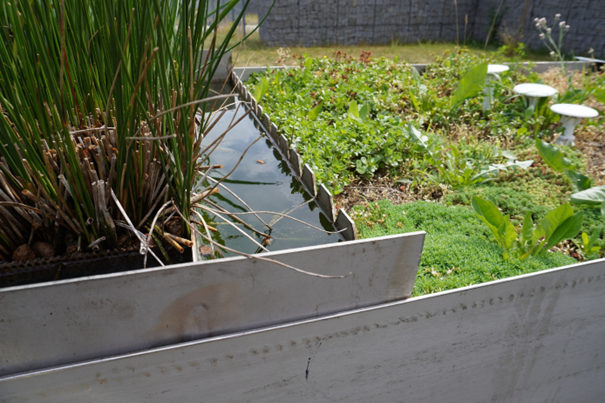
These include, for example, green roofs combined with constructed wetlands, which make use of natural processes occurring
in soil and vegetation to treat water and enable its reuse. Water reuse is currently one of the most relevant topics in sustainable
water management, and in our research, it is reflected in a wide range of projects and international collaborations that connect
experimental research, modeling, and the practical application of nature-based solutions. As part of the INTER-EXCELLENCE
II / INTER-COST project, research is underway on Modeling and Optimization of the Transport Processes in Porous Systems of
Nature Based Solutions for Wastewater Reuse. The project supports the involvement of the Czech research team in an international
scientific collaboration network within the COST programme, which connects experts from many European countries. Its aim is
to better understand how water and dissolved substances move through the porous materials of these systems and how these processes
can be optimized for more efficient water treatment and reuse.
We are looking for ways to use water wisely, efficiently, and sustainably—for cities and future generations.